

The Symphony of Group Dynamics
Finding Harmony in Music, Leadership, and Life by Banu Cetin

Last Saturday, as I sat in the Philharmonie Luxembourg, immersed in the monumental performance of Verdi’s Requiem, I found myself captivated by more than just the music. What unfolded before me was a masterclass in group dynamics—a living demonstration of how individuals, each with their unique roles, come together to create something far greater than the sum of their parts.
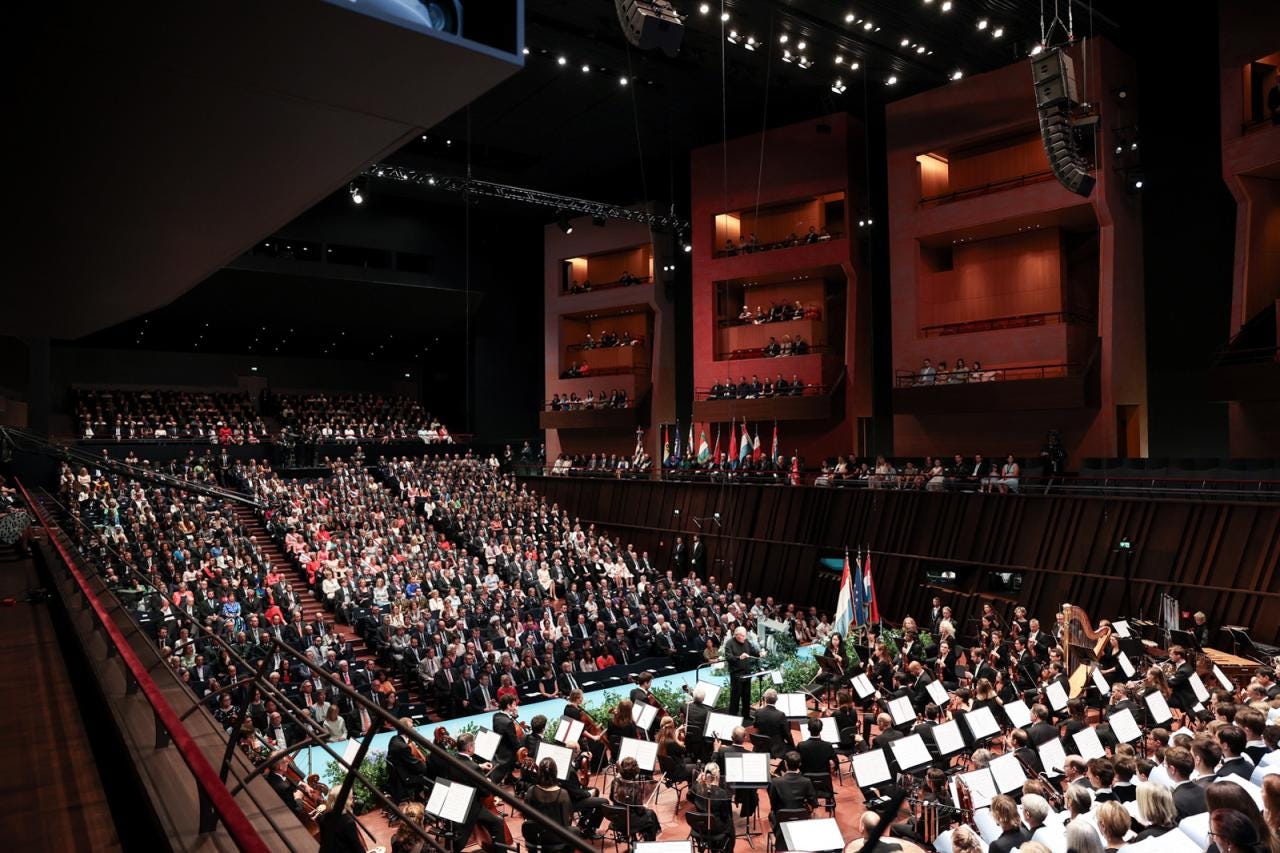
A choir of 80+, a full orchestra of 50+ instruments, four soloists, and the music director all moved as one, guided by an invisible yet undeniable structure. Each musician knew their place, their moment to shine, and when to step back in service of the whole. It was a striking parallel to how organizations, teams, and even societies function—reminding me that these patterns of collaboration exist everywhere, from the concert hall to the boardroom.
The Hidden Structure Behind Large Groups: OC16
In the corporate world, we often talk about leadership, teamwork, and efficiency, but what really makes large groups work well together? How do companies with thousands of employees ensure alignment? How does an orchestra with over a hundred people create harmony without chaos?
The answer lies in a concept called OC16, a principle from Human Design for Business that explains how large-scale organizations and teams function. OC16 refers to the moment a group grows beyond nine people and transforms into a structured, hierarchical system that operates as a unified whole.
The same mechanics that make a large business successful are at play in a great musical performance: leadership, structure, synchronization, and respect for the collective flow.
Verdi’s Requiem: A Composition Built on Unity and Contrast
Giuseppe Verdi, known for his dramatic operatic genius, composed Requiem as a deeply emotional and theatrical piece, blending sacred intensity with the drama of the opera. Unlike traditional religious masses, Requiem moves between moments of explosive grandeur (Dies Irae) and delicate vulnerability (Agnus Dei), requiring absolute precision from every performer.
This delicate balance mirrors how high-functioning organizations operate:
There is a structured hierarchy, but also room for dynamic movement.
Leadership is strong, yet contributions come from all levels.
The whole is greater than the sum of its parts.
The Beauty of Group Flow: How Large-Scale Collaboration Works
Watching the orchestra and choir move through Requiem was a perfect example of how large groups, even with their many layers, can work in near-perfect harmony. There were no unnecessary movements, no wasted effort—just a collective trust in the system.
This reflects a fundamental truth about group dynamics: successful collaboration isn’t about individual dominance; it’s about alignment.
In a large-scale performance like Requiem, just as in business, leadership, or even nature, effective group flow depends on:
A Clear Visionary (The Conductor / OC16 Alpha): The one who sets the pace, shapes the energy, and guides the whole without micromanaging.
Defined Roles (Musicians & Choir / Functional Teams): Each person plays a specific part, understanding when to lead and when to support.
Seamless Communication (Nonverbal Cues & Timing / Corporate Coordination): The group listens as much as it acts, responding with perfect synchronicity.
Respect for the Collective (Trust in the Structure): Every musician knows that the whole only works if each part functions as intended.
The Dance Between Leadership and Collaboration
At the heart of the performance was the conductor—a single figure standing before the vast ensemble, yet not making a single sound himself. His power lay in his ability to channel the energy of the group, to direct without controlling, to extract the right performance at the right time.
This is the essence of great leadership. The best leaders, like great conductors, don’t need to dictate every move. Instead, they create an environment where each person’s contribution is valued, and where individuals instinctively know when to act and when to step back.
The soloists, much like key executives in an organization, had their moments to shine. Yet, even in their brilliance, they remained within the fabric of the whole. Their voices rose with power and grace, yet they never overpowered the ensemble—just as strong leaders know when to take the stage and when to empower their teams.
OC16 in the Workplace: Lessons from the Orchestra
The same way an orchestra follows the conductor’s guidance without rigid control, a business functions best when leadership provides direction and holds the communication channels but trusts its people to execute. Too much control, and creativity is lost. Too little structure, and chaos ensues. The magic happens when alignment is achieved.
The Rhythm of Life: Group Dynamics Everywhere
What was also striking about the performance was how effortlessly these dynamics played out—not because they were forced, but because they were natural. Groups, when functioning at their best, follow an organic rhythm, whether in music, business, sports, or even daily interactions.
We see it everywhere:
A sports team, moving in sync without words, each player instinctively knowing where to be.
A company, where the CEO, managers, and employees all contribute to a shared goal.
A family, where each member plays a role, balancing independence with collective support.
A conversation, where listening and responding create a flow that is as much about timing as it is about words.
Even in nature, this pattern repeats. Flocks of birds migrate in perfect formations, schools of fish shift direction in unison, trees in a forest communicate through underground networks. Harmony emerges not from control, but from alignment.
When Group Dynamics Become Art
Verdi’s Requiem was a profound expression of what is possible when individuals unite under a common purpose. The beauty of group dynamics is that they are everywhere, shaping how we work, lead, connect, and create.
The invisible threads of structure, timing, and trust are always there, guiding the way. Just like in a symphony, the magic is in any one person’s contribution and in the way it all comes together.
So, imagine if we knew how the unseen energy dynamics of a large team work and we could use it for business success. This is really where the business applications knowledge of human design come handy and serve us as individuals and the larger organizations we are part of.
Warmly,
Banu Cetin